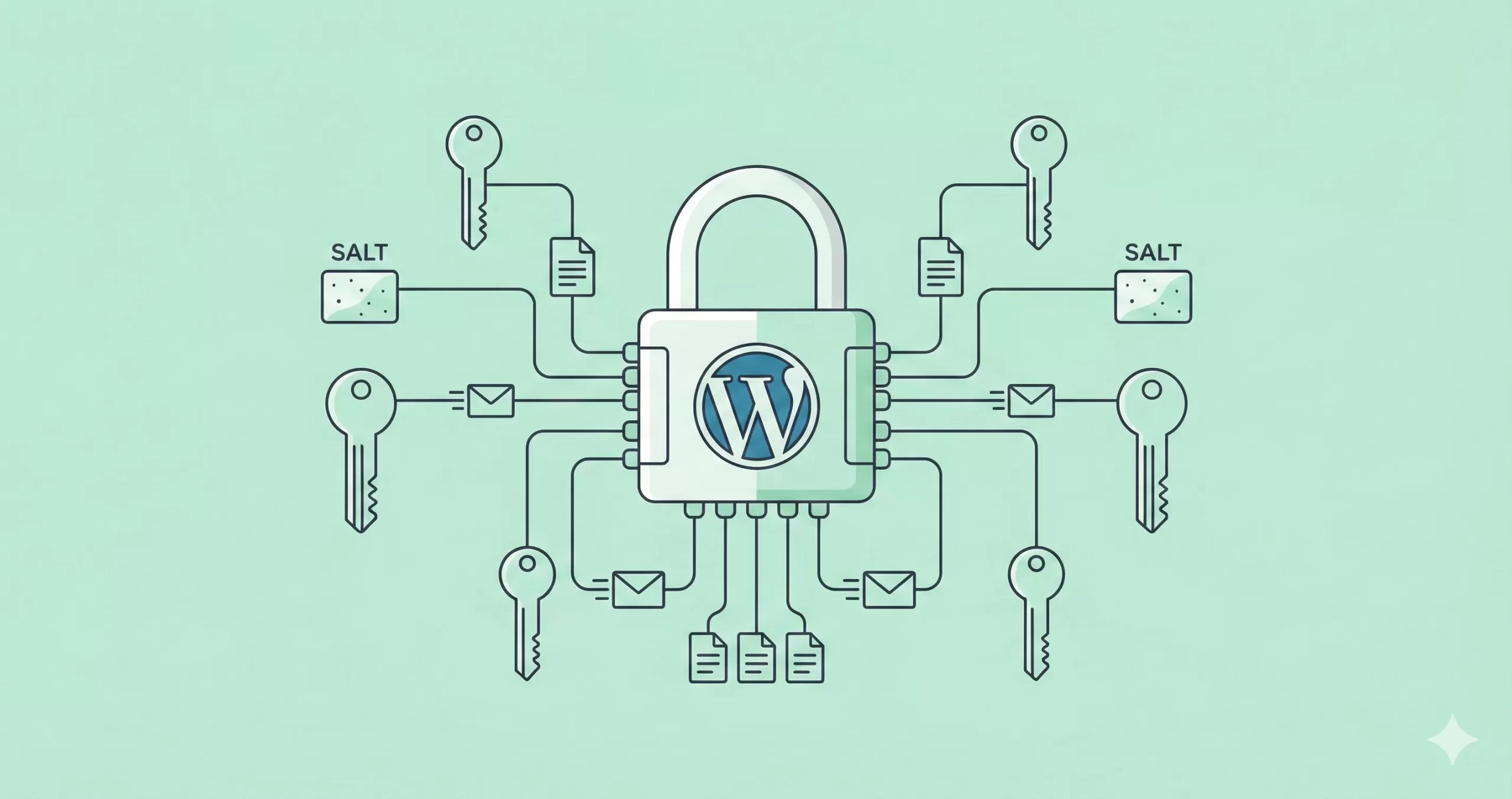
Secure Your Website with Our Advanced WordPress Salt Generator
Security is the backbone of any successful website. While we often focus on strong passwords and reliable hosting, one crucial aspect of WordPress security often goes overlooked: your security keys. This page features a powerful WordPress Salt Generator designed to help you instantly improve your site’s defense mechanisms against brute force attacks and cookie hijacking.
Whether you are setting up a fresh installation or performing maintenance on an existing blog, using a reliable WordPress Salt Generator is a mandatory step in hardening your website.
What Are WordPress Salts and Security Keys?
If you have ever opened your wp-config.php file, you might have noticed a block of code looking like random gibberish. These are your WordPress security keys and salts. In simple terms, they are cryptographic variables that secure your login information and cookies.
Think of them as the secret ingredients in a recipe that only your website knows. Even if a hacker manages to steal your database, they cannot easily crack your passwords because these “salts” add an extra layer of complexity to the encryption. A robust WordPress Salt Generator ensures that these secret ingredients are completely random and impossible to guess.
How Do WordPress Salts Work?
When you log into WordPress, the system stores your login information in cookies on your browser. This allows you to stay logged in without typing your password every time you refresh a page. However, storing passwords in cookies—even encrypted ones—can be risky.
This is where the keys come in. WordPress uses the keys generated by a WordPress Salt Generator to turn your password into a complex hash before storing it. There are four main keys, each with a corresponding salt:
- AUTH_KEY: Used to sign authorization changes.
- SECURE_AUTH_KEY: Used to sign SSL admin transfers.
- LOGGED_IN_KEY: Used to create the cookie for a logged-in user.
- NONCE_KEY: Used to sign nonces (tokens that protect against CSRF attacks).
How to Use This WordPress Salt Generator Tool
We have designed this tool to be fast, secure, and incredibly easy to use. You do not need any coding knowledge to secure your site. Just follow these steps:
- Choose Length (Optional): The default length is 64 characters, which is the industry standard. However, our WordPress Salt Generator allows you to customize this if you have specific security requirements.
- Generate: Click the “Generate New Salts” button. The tool will instantly create a unique set of random keys.
- Copy: Click the “Copy to Clipboard” button or click directly on the text box to copy the code.
- Update: Paste these new keys into your
wp-config.phpfile.
Tip: Try our Free WordPress .htaccess Rules Generator
How to Change Your WordPress Salts Manually
Once you have your new keys from our WordPress Salt Generator, you need to add them to your site. This requires accessing your website files, usually via FTP (like FileZilla) or the File Manager in your hosting control panel (cPanel).
Step 1: Locate wp-config.php
Connect to your website server and look for the wp-config.php file in the root directory (usually public_html).
Step 2: Edit the File
Open the file and scroll down until you see the section labeled “Authentication Unique Keys and Salts.” It will look something like this:
define( 'AUTH_KEY',         'put your unique phrase here' );
define( 'SECURE_AUTH_KEY',  'put your unique phrase here' );
define( 'LOGGED_IN_KEY',    'put your unique phrase here' );
define( 'NONCE_KEY',        'put your unique phrase here' );
define( 'AUTH_SALT',        'put your unique phrase here' );
define( 'SECURE_AUTH_SALT', 'put your unique phrase here' );
define( 'LOGGED_IN_SALT',   'put your unique phrase here' );
define( 'NONCE_SALT',       'put your unique phrase here' );
Step 3: Replace and Save
Delete those 8 lines and paste the fresh code you copied from our WordPress Salt Generator. Save the file and upload it back to the server.
Note: As soon as you save this file, all logged-in users (including yourself) will be instantly logged out. This is a good thing—it means the old cookies are now invalid.
Do You Need to Periodically Change Your Salts?
While you do not need to change them every week, it is good practice to use a WordPress Salt Generator to refresh your keys periodically. You should definitely change them immediately in the following scenarios:
- After a Hack: If your site was compromised, changing salts is mandatory to force-logout any attackers who might still have valid cookies.
- Public Computer Usage: If you accidentally logged into your admin panel from an insecure public Wi-Fi or a library computer.
- Change of Staff: If an administrator or editor leaves your organization, changing the salts ensures they cannot access the site using old browser sessions.
Privacy and Security: Is This Tool Safe?
Yes, absolutely. Unlike many other online tools, our WordPress Salt Generator runs entirely in your browser using JavaScript. We utilize the window.crypto API, which is the standard for cryptographic security on the web.
This means the keys are generated locally on your device. They are never sent to our server, stored in our database, or seen by anyone else. You get the same level of randomness as the official WordPress API, but with the added convenience of our custom interface.
Frequently Asked Questions (FAQs)
What happens if I don’t use a WordPress Salt Generator?
If you leave the default “put your unique phrase here” text in your config file, or use weak keys, hackers can easily predict your encryption salts. This makes your site vulnerable to “rainbow table” attacks where they can crack your password hashes much faster.
Will changing salts break my site?
No, using a WordPress Salt Generator to update your keys will not break your site. However, it will invalidate all current login sessions. You and your users will simply need to log in again.
Can I type these keys manually?
Technically, yes, but humans are terrible at being random. We tend to use patterns that computers can guess. A programmatic WordPress Salt Generator creates a chaotic, unpredictable string of characters that provides mathematically superior security.